DBE Variants
Understanding the genetic diversity behind the Dominant Blue Eye phenotype.
Not all DBE variants are biologically equivalent.
1. Introduction
Understanding DBE Starts with Understanding the PAX3 Gene
Dominant Blue Eyes (DBE) is not caused by a single genetic variant. Several different genetic variants can produce a similar blue-eye phenotype, but they do not affect the PAX3 gene in the same way.¹ ² ³ ⁴
Before comparing these variants, it is important to understand how a gene is organised, what the PAX3 protein does, and why the location of a mutation can influence its biological effect.
2. What is the PAX3 Gene?
Most nucleated cells in a cat's body contain DNA organised into 38 chromosomes, arranged in 19 pairs. Chromosomes contain many genes.
The PAX3 gene contains the instructions for producing the PAX3 protein. PAX3 is a transcription factor that helps regulate the development and migration of melanocytes — the pigment-producing cells of the skin, coat, eyes and inner ear — in part by acting as an upstream regulator of the MITF gene.¹ ³
The PAX3 gene, associated with several Dominant Blue Eye (DBE) variants, is located on chromosome C1.¹
3. How Is a Gene Structured?
A gene is a continuous region of DNA, but protein-coding genes are usually divided into two types of segments: exons and introns.
Exons
Exons contain the sequence used to build the protein. These regions remain in the mature messenger RNA (mRNA) and their coding portion is translated into the final protein.
Introns
Introns are located between exons and are removed from the initial RNA transcript during splicing. Although introns are not translated into protein, some intronic regions contain regulatory elements that may influence gene expression or RNA processing.
Because of these different functions, mutations in exons and introns can have very different biological consequences.
4. Why does the mutation location matter?
The location of a mutation is just as important as the mutation itself. Variants occurring in different regions of the same gene can influence gene function through entirely different molecular mechanisms.
5. Understanding the Difference
Non-coding variants
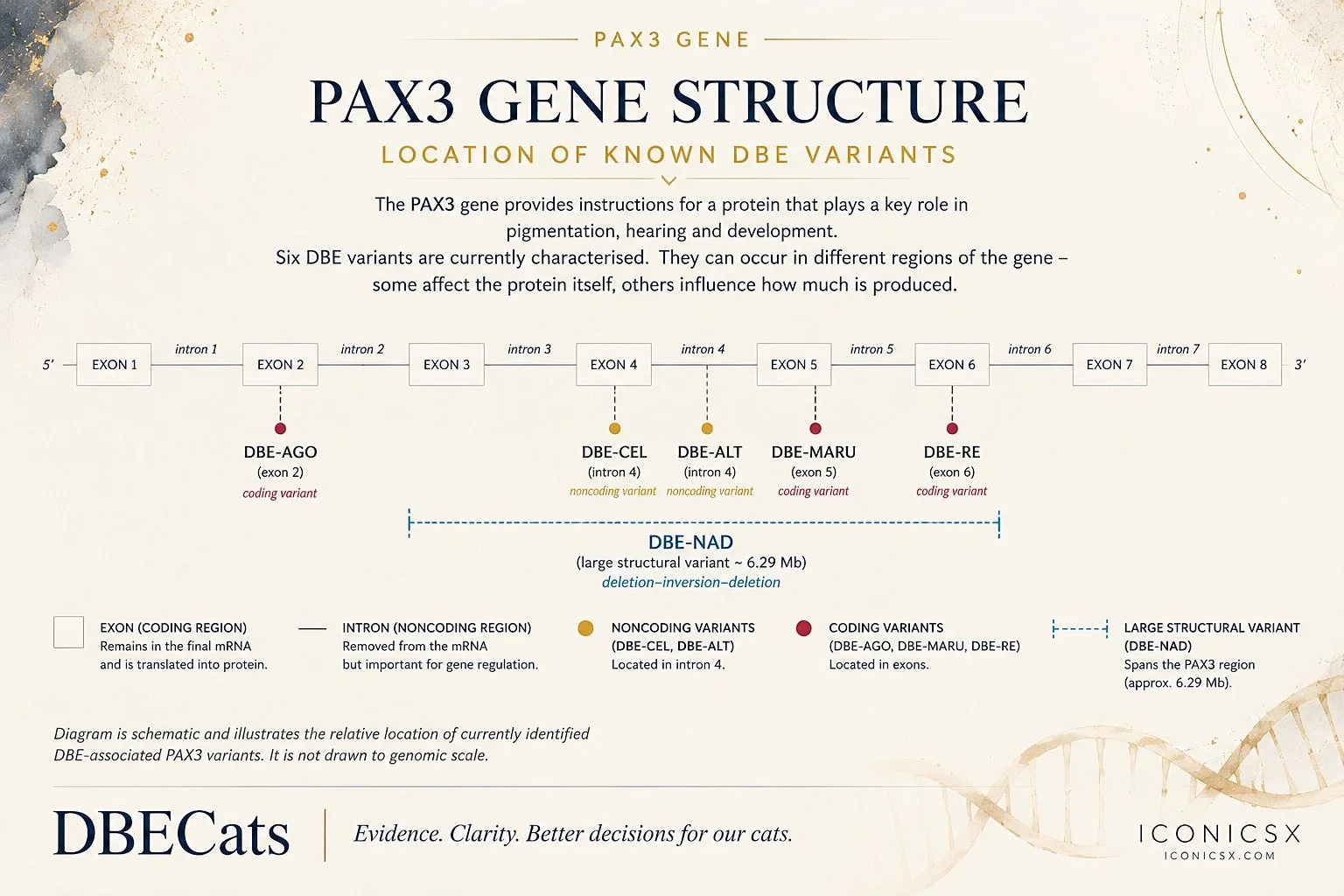
Non-coding variants occur outside the protein-coding sequence, including within introns. They do not directly alter the protein-coding DNA sequence, but they may affect gene regulation or RNA processing. DBE-CEL and DBE-ALT are distinct LTR insertions within intron 4 of PAX3, in a region containing conserved regulatory elements. Their precise effects on PAX3 expression and protein abundance have not yet been demonstrated experimentally.¹
Coding variants
Coding variants occur within exons, the regions that encode the protein. Because they directly alter the sequence that is translated, they may change the protein’s amino acid sequence, reduce its function, or prevent it from functioning normally. The DBE-RE and DBE-AGO variants are examples of protein-changing variants in PAX3.³ ⁴
6. Why This Matters
Grouping all DBE variants together can lead to oversimplified conclusions. Identifying the specific variant provides a more accurate framework for interpreting scientific literature, assessing potential biological effects, and making informed breeding decisions.
Known PAX3 Variants
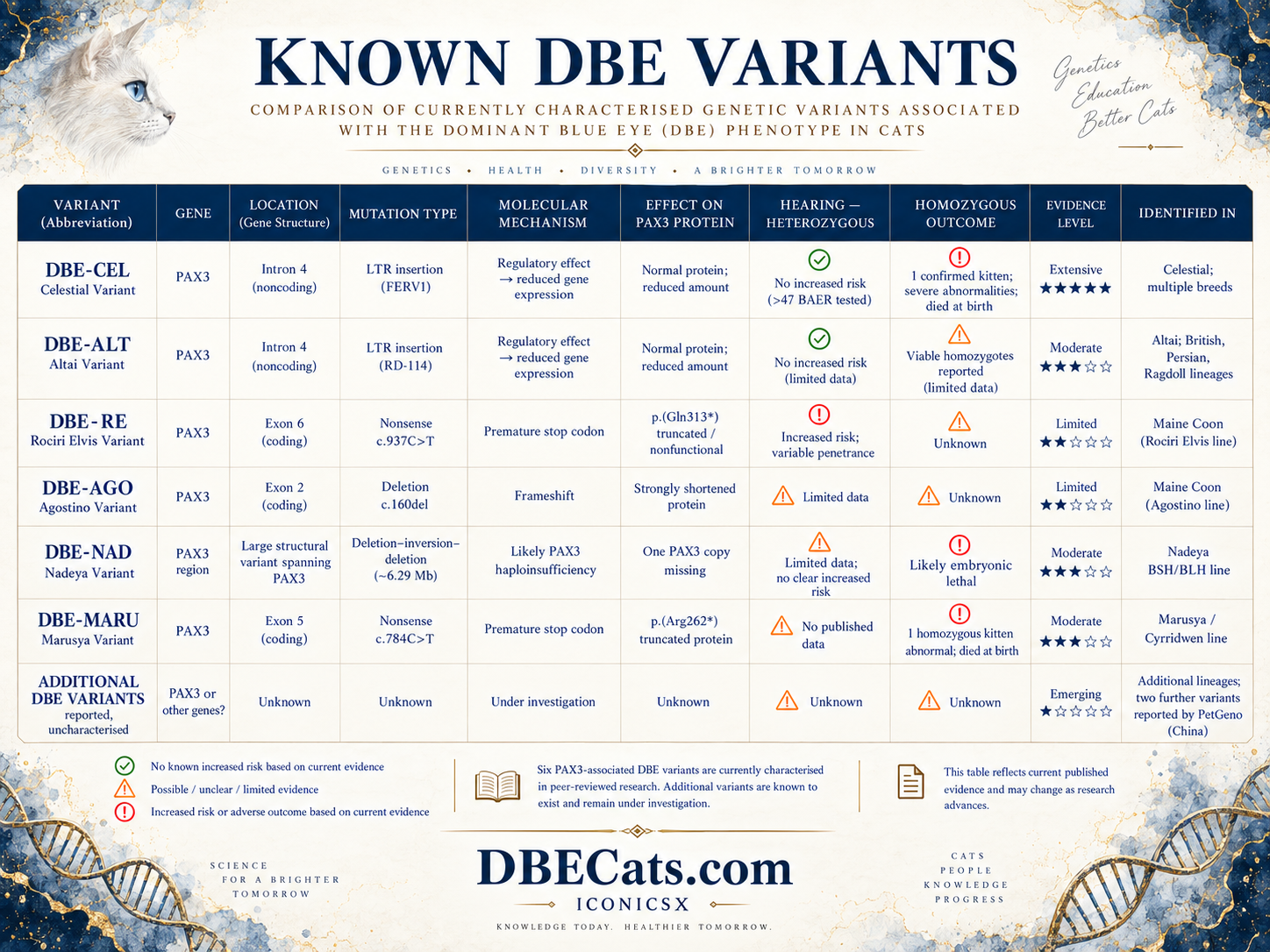
Several independent PAX3 variants have now been identified as being associated with the Dominant Blue Eyes phenotype.
Although these variants affect the same gene, they differ in their genomic location, mutation type and predicted molecular consequences. Some occur within protein-coding exons, while others are located in non-coding introns. As a result, they are not expected to affect PAX3 function in the same way.
Current evidence indicates that these variants should be interpreted individually rather than considered as a single genetic entity.
The currently characterised PAX3-associated DBE variants are presented below.
-
DBE Celestial
DBE-CEL is a non-coding intronic variant of the PAX3 gene, first described by Abitbol et al. (2024). It consists of a FERV1 LTR insertion within intron 4 of PAX3, close to conserved non-coding elements involved in the regulation of PAX3 expression. It is currently the best-characterised non-coding variant associated with the Dominant Blue Eye (DBE) phenotype.
-
DBE Altai
DBE-ALT is a non-coding intronic variant of the PAX3 gene, first described by Abitbol et al. (2024). It consists of an RD-114 LTR insertion within intron 4 of PAX3, close to conserved non-coding elements involved in the regulation of PAX3 expression, and represents an independently arising Dominant Blue Eye (DBE) variant.
-
DBE Rociri Elvis
DBE-RE is a coding nonsense variant of the PAX3 gene, first described by Rudd Garces et al. (2024) in Maine Coon cats. Unlike DBE-CEL and DBE-ALT, which are intronic variants with proposed regulatory effects, DBE-RE occurs within the protein-coding sequence of PAX3. The variant introduces a premature stop codon and is predicted to disrupt normal PAX3 function.
-
DBE Agostino
DBE-AGO is the fourth currently characterised PAX3 variant associated with the Dominant Blue Eyes phenotype. It was first described by Abitbol et al. (2025) in the Agostino Maine Coon lineage. Unlike DBE-CEL and DBE-ALT, which are intronic variants with proposed regulatory effects, DBE-AGO is a coding frameshift variant predicted to produce a severely truncated PAX3 protein.
-
DBE Nadeya
DBE-NAD is a large genetic change affecting the region that contains the PAX3 gene, first described by Abitbol et al. (2026). It was identified in the Ermine Trace Nadeya line of British Shorthair and British Longhair cats, founded in Russia in 2016. Unlike DBE-CEL or DBE-ALT, which are small changes located within PAX3, DBE-NAD involves a much larger section of chromosome C1.
-
DBE Marusya
DBE-MARU is a coding variant of the PAX3 gene, first described by Abitbol et al. (2026). It was identified in the Cyrridwen Marusya line, which began in Russia in 2019 with an outbred Domestic Shorthair female named Marusya.
Exotic Shorthair, Persian and British cats were later used in the development of the line.
-
DBE Chinese Domestic Cat
DBE-CDC (also listed as DBE5 in some commercial testing panels) is a variant currently offered for genetic testing by at least one laboratory but not yet described in the peer-reviewed scientific literature. As of 2026, no published study, preprint or OMIA entry characterises this variant.
-
DBE XinHe Winnie
DBE-XHW (also listed as DBE6 in some commercial testing panels) is a variant currently offered for genetic testing by at least one laboratory but not yet described in the peer-reviewed scientific literature. As of 2026, no published study, preprint or OMIA entry characterises this variant.
References
Abitbol M, Couronné A, Dufaure de Citres C, Gache V. A PAX3 insertion in the Celestial breed and certain feline breeding lines with dominant blue eyes. Animal Genetics. 2024;55(4):670–675. doi:10.1111/age.13433
Abitbol M, Dufaure de Citres C, Rudd Garces G, Lühken G, Lyons LA, Gache V. Different Founding Effects Underlie Dominant Blue Eyes (DBE) in the Domestic Cat. Animals. 2024;14(13):1845. doi:10.3390/ani14131845
Rudd Garces G, Farke D, Schmidt MJ, Letko A, Schirl K, Abitbol M, Leeb T, Lyons LA, Lühken G. PAX3 haploinsufficiency in Maine Coon cats with dominant blue eyes and hearing loss resembling the human Waardenburg syndrome. G3 Genes|Genomes|Genetics. 2024;14(9):jkae131. doi:10.1093/g3journal/jkae131
Abitbol M, Cloquell A, Kaczmarska A, Holmes K, Lühken G, Macaulay K. Dominant blue eyes in Maine Coon cats: New PAX3 variant and updated phenotypic data. Animal Genetics. 2025;56(3):e70020. doi:10.1111/age.70020